
Somatic Experiencing vs. CBT: Two Different Paths to Healing Trauma and Anxiety
Somatic Experiencing | CBT | Trauma | Nervous System Regulation
When people start therapy, they often assume healing happens through talking things out, changing thoughts, and gaining insight. For many, that is helpful. For others, it can feel like something is missing.
You may understand your anxiety logically, yet your body still panics. You may know your trauma is in the past, but your nervous system does not seem to believe it. This is where the difference between Cognitive Behavioral Therapy (CBT) and Somatic Experiencing (SE) becomes especially important.
Both approaches are valid. They simply work in very different ways.
What Is CBT?
Cognitive Behavioral Therapy, or CBT, is one of the most widely used and researched therapy models. It focuses on the connection between thoughts, feelings, and behaviors.
CBT helps clients:
Identify unhelpful or distorted thinking patterns
Challenge and reframe negative thoughts
Develop coping strategies and skills
Practice behavior changes through homework and repetition
CBT is structured, goal-oriented, and often time-limited. It can be especially effective for conditions like depression, generalized anxiety, and phobias, particularly when thoughts are driving emotional distress.
What Is Somatic Experiencing?
Somatic Experiencing is a body-based therapy that focuses on the nervous system rather than thoughts alone. Developed to address trauma and chronic stress, SE is based on the understanding that trauma lives in the body as much as the mind.
Instead of analyzing thoughts, SE helps clients:
Tune into physical sensations
Notice patterns of activation and calm
Gently release stored survival energy
Build nervous system regulation and resilience
SE does not require retelling traumatic stories or changing beliefs through logic. Healing happens through the body’s natural ability to reset when given safety, time, and support.
The Key Difference: Top-Down vs. Bottom-Up Healing
One of the biggest differences between CBT and Somatic Experiencing is how they approach change.
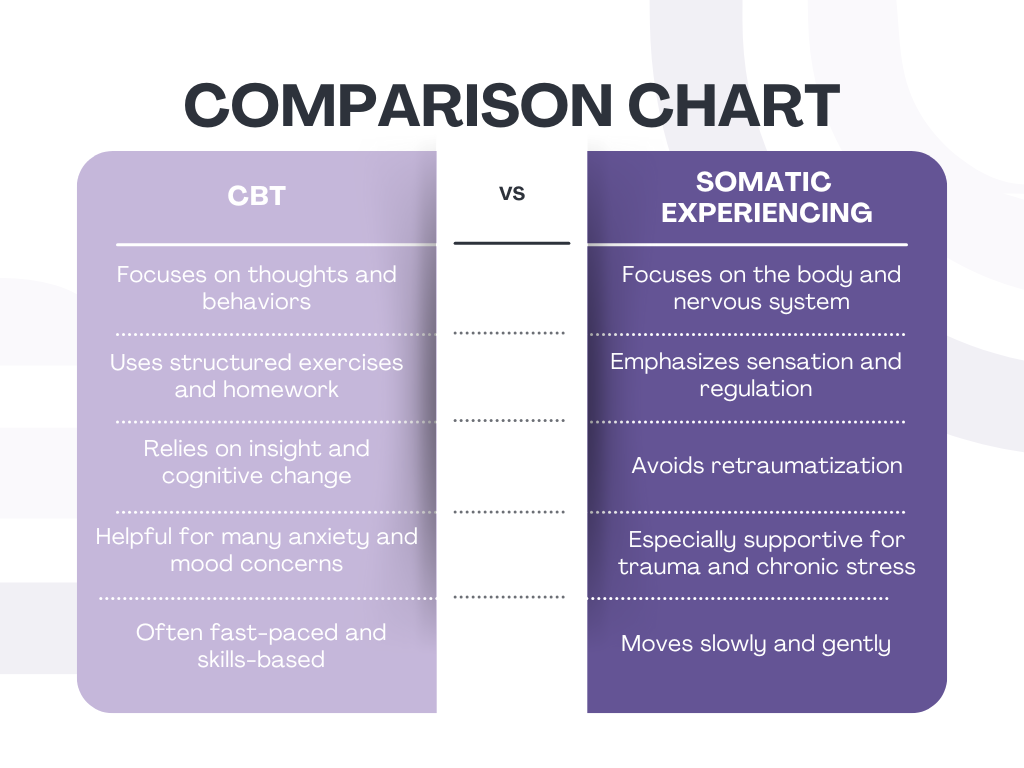
CBT uses a top-down approach. It starts with thoughts and beliefs, aiming to influence emotions and behaviors through cognitive shifts.
Somatic Experiencing uses a bottom-up approach. It starts with the body and nervous system, allowing emotional and cognitive changes to emerge naturally as regulation improves.
For some people, changing thoughts is enough. For others, especially those with trauma histories, the nervous system remains activated even when thoughts are rational and compassionate.
A Side-by-Side Comparison
Which One Is Right for You?
There is no single right answer. The best approach depends on your nervous system, your history, and your needs.
CBT may be a good fit if:
You enjoy structure and clear strategies
Your thoughts strongly drive your distress
You want practical tools you can apply daily
Somatic Experiencing may be a better fit if:
You feel stuck despite insight
Your body reacts before your mind can catch up
You experience panic, shutdown, or dissociation
Talking about trauma feels overwhelming
At Realign Your Mind Counseling Services, we often integrate approaches rather than choosing just one. Many clients benefit from using CBT skills alongside somatic work, allowing both the mind and body to heal together.
Final Thoughts
You are not resistant to therapy if CBT has not fully worked for you. Your nervous system may simply need a different doorway into healing.
Somatic Experiencing and CBT offer two distinct but complementary paths. One focuses on changing how you think. The other focuses on helping your body feel safe again.
Healing does not have to be forced. When the nervous system settles, clarity often follows.
Interested in exploring somatic-based therapy or integrative approaches?
Contact Realign Your Mind Counseling Services to learn how we tailor therapy to meet both your mind and body where they are.
